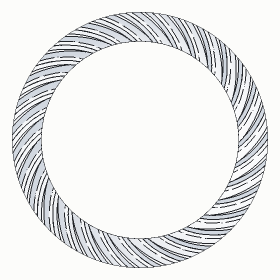
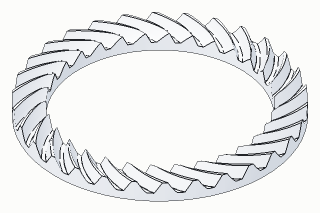
A face gear's 30 teeth cut whole by a cylindrical worm turning in mesh with it, as a hob cuts: a helicon pair, the worm over the gear's face on a shaft square to the gear's and 30 from it.
This is the fourth of five cases that cut a gear with its mate as the shafts move apart, from the straight bevel and the hypoid through the spiroid to the worm wheel. Its worm is the worm wheel's; here it lies over the gear's face, where the worm wheel's lies beside its rim.
The blank is the ring about the z axis between radii 40 and 52, from z = −6 to z = 2: the gear's pitch plane is z = 0, and its teeth will stand 2 above it.
The worm's axis is the line through (0, 30, 10) along the x axis: square to the z axis and 30 from it, 10 above the pitch plane. For a point p write x for its x coordinate, r for its distance from the worm's axis, and θ for its angle about the axis, right-handed about +x: (y − 30, z − 10) = r·(cos θ, sin θ).
The tool is the worm's thread: the points with 0 ≤ x ≤ 52, 7.5 ≤ r ≤ 12.5 and |ξ| ≤ π/2 − (r − 10)·tan 20°, where ξ is x − θ reduced to the interval [−π, π) by a multiple of 2π. It is a right-hand thread of lead 2π, one start: its section by any plane through the axis is a row of trapezoids 2π apart (a rack of module 2), each π wide at radius 10 (its pitch line touches the pitch plane along y = 30), from radius 7.5 to 12.5, its sides 20° from square to the axis. Its ends are the planes x = 0 and x = 52, and it lies on one side of the gear's axis only, so it crosses the ring once. The worm's core (r ≤ 7.5) never reaches the blank, so a worm with its core cuts the same.
The motion. The worm turns by t about its axis, right-handed about +x (from +y toward +z), while the gear turns by t/30 about the z axis. Seen from the gear, the worm at t is turned by t about its axis and then by −t/30 about the z axis. t runs from 0 to 60π: thirty turns of the worm and one of the gear, after which each stands as it began. Cut from the blank everything the worm passes through, seen from the gear. Its ends never reach the blank.
As for the worm wheel, the thread is a screw's, so seen from the gear the worm is a rack slid along its axis while the gear turns. But the rack now crosses the gear's face, which moves along the worm's axis as fast as the rack only on the line y = 30, and moves across it everywhere but at x = 0. The gear's teeth run across the face, curved, thinner at the ring's inner edge and fuller at its outer.
where K is the blank, T the thread and W the worm's axis.
Unsettled. This solid has no closed form, and no two kernels yet agree on it to 1e-8, so it has no answer to grade against. Below is what each kernel builds: built means a watertight, consistently oriented solid, whatever its measures; the table says which kernels agree with which.
Drawing
TopIsometricFrontRight
Third-angle projection, the three views at one scale. Drawn from next.BREP's result, which passed.
† works around a missing feature. Pick an entry to see its solid, its measures and its code.
Drag to turn, scroll or pinch to zoom, right-drag to move. The solid as its STEP file has it, meshed in the browser by Open CASCADE (occt-import-js): each face colored by the kind of its surface, and the edges that bound each face drawn between them.
Drag to turn, scroll or pinch to zoom, right-drag to move. Black lines are where the surface turns sharply; red ones, seen through the solid, are open edges, where the mesh is not closed.
cad-kernel left no solid to show.
Time
53 ms; CPU time 150 ms; peak memory 12.1 MB
Notes
refused the worm's sweep not cut: Curved { at: [-2.818851427516084e-16, 24.079064504830807, 14.603533736386161] }
//! A face gear, the ring between radii 40 and 52 about the z axis from z = −6 to 2, hobbed whole by//! a single-start worm (lead 2π, pitch radius 10) on the line through (0, 30, 10) along x, from//! x = 0 to 52: the worm turns by t about its axis while the gear turns by t/30, t from 0 to 60π.//!//! The ring is a disc less a disc, each a prism; the thread its axial trapezoid screwed//! (`build::screwed`, exact), cut to its ends and placed.//!//! Refused by the kernel at run time. Seen from the gear the worm's turn is no constant twist, and//! the kernel's sweep cut from a blank (`swept::closed::cut_from`) reads a tool under such a motion//! only as a convex solid of revolution (K2) or as all planes and lines (`swept::general`); the//! thread's helicoidal flanks are neither, and it is refused by what it is (`Unbuilt::Curved`).usecrate::gears::hobbed;
use cad_kernel::boolean::{combined, Op};
use cad_kernel::build::{disc, prism};
use cad_kernel::topo::Brep;
pubfnbuild() -> Result<Brep, String> {
let up = [0., 0., 1.];
let outer = prism(&disc([0., 0., -6.], up, 52.), 0., 8.)?;
let bore = prism(&disc([0., 0., -7.], up, 40.), 0., 10.)?;
let ring = combined(&outer, &bore, Op::Cut, 0.)?;
hobbed(&ring, [0., 30., 10.], 0., 52.)
}
occt left no solid to show.
Time
619 ms; CPU time 618 ms; peak memory 356.6 MB
Notes
refused occt has no sweep of a solid under two turns about skew axes at once (or, the thread being a screw's, under a slide and a turn at once), and the face gear's flanks are the envelope of the thread's, which occt has no operation to find
"""A helicon face gear hobbed by its worm. A face gear's 30 teeth cut whole by a cylindrical worm
turning in mesh with it, as a hob cuts: a helicon pair, the worm over the gear's face on a shaft
square to the gear's and 30 from it.
This is the fourth of five cases that cut a gear with its mate as the shafts move apart, from the
straight bevel and the hypoid through the spiroid to the worm wheel. Its worm is the worm wheel's;
here it lies over the gear's face, where the worm wheel's lies beside its rim.
The blank is the ring about the z axis between radii 40 and 52, from z = −6 to z = 2: the gear's
pitch plane is z = 0, and its teeth will stand 2 above it.
The worm's axis is the line through (0, 30, 10) along the x axis: square to the z axis and 30 from
it, 10 above the pitch plane. For a point p write x for its x coordinate, r for its distance from
the worm's axis, and θ for its angle about the axis, right-handed about +x: (y − 30, z − 10) =
r·(cos θ, sin θ).
The tool is the worm's thread: the points with 0 ≤ x ≤ 52, 7.5 ≤ r ≤ 12.5 and |ξ| ≤ π/2 − (r −
10)·tan 20°, where ξ is x − θ reduced to the interval [−π, π) by a multiple of 2π. It is a right-
hand thread of lead 2π, one start: its section by any plane through the axis is a row of trapezoids
2π apart (a rack of module 2), each π wide at radius 10 (its pitch line touches the pitch plane
along y = 30), from radius 7.5 to 12.5, its sides 20° from square to the axis. Its ends are the
planes x = 0 and x = 52, and it lies on one side of the gear's axis only, so it crosses the ring
once. The worm's core (r ≤ 7.5) never reaches the blank, so a worm with its core cuts the same.
The motion. The worm turns by t about its axis, right-handed about +x (from +y toward +z), while
the gear turns by t/30 about the z axis. Seen from the gear, the worm at t is turned by t about its
axis and then by −t/30 about the z axis. t runs from 0 to 60π: thirty turns of the worm and one of
the gear, after which each stands as it began. Cut from the blank everything the worm passes
through, seen from the gear. Its ends never reach the blank.
As for the worm wheel, the thread is a screw's, so seen from the gear the worm is a rack slid along
its axis while the gear turns. But the rack now crosses the gear's face, which moves along the
worm's axis as fast as the rack only on the line y = 30, and moves across it everywhere but at x =
0. The gear's teeth run across the face, curved, thinner at the ring's inner edge and fuller at its
outer."""from bench importRefuseddefbuild():
# The thread occt could make (a pipe shell of the rack's trapezoid along a helix), but not what it# fills as it turns about its axis while the gear turns: seen from the gear it is a rack slid# along its axis while turned about the z axis, a motion none of occt's sweeps (a slide, a turn,# a path) makes, and the gear's flanks are the envelope of the thread's under it.raiseRefused("occt has no sweep of a solid under two turns about skew axes at once (or, the ""thread being a screw's, under a slide and a turn at once), and the face gear's"" flanks are the envelope of the thread's, which occt has no operation to find")
arris left no solid to show.
Time
It has not run.
Notes
missing no implementation
Data
No measures: it built no solid to measure.
Implementation
No implementation yet.
kentron left no solid to show.
Time
1.3 ms; CPU time 1.1 ms; peak memory 3.7 MB
Notes
refused kentron's cut by a motion takes a solid of revolution screwed or turned about one axis, or a prism moved in its plane; the worm's thread is neither, turned in mesh about two skew axes, and the teeth's flanks are an envelope kentron has no operation to find
//! A face gear's 30 teeth cut by a worm turning in mesh with it: from the ring about the z axis//! between radii 40 and 52, z from −6 to 2, everything the worm's thread (about the line through//! (0, 30, 10) along x, lead 2π, a rack of module 2 in section) passes through as it turns by t//! about its axis and the gear by t/30 about the z axis, t from 0 to 60π, seen from the gear.//!//! Refused. kentron's cut by a motion (`sweep::cut_by_motion`) takes the motion as steps, the worm's//! turn and the gear's taken back, but cuts only a prism moved in its plane, or a solid of//! revolution screwed or turned about a single axis: the thread is no solid of revolution, and//! two turns about skew axes make no plane problem. Seen from the gear the thread is a rack slid//! along its axis while the gear turns, so the teeth's flanks are the envelope of the rack's//! flanks under that rolling, which kentron has no operation to find.usecrate::Refusal;
use kentron::topology::{Model, Shape};
pubfnbuild(_m: &mutModel) -> Result<Shape, Refusal> {
Err(Refusal::from(
"kentron's cut by a motion takes a solid of revolution screwed or turned about one axis, or a \
prism moved in its plane; the worm's thread is neither, turned in mesh about two skew axes, \
and the teeth's flanks are an envelope kentron has no operation to find",
))
}
vcad left no solid to show.
Time
It has not run.
Notes
missing no implementation
Data
No measures: it built no solid to measure.
Implementation
No implementation yet.
solidcraft left no solid to show.
Time
1.8 ms; CPU time 1.5 ms; peak memory 4.6 MB
Notes
refused no layer (solidcraft-kernel, solidcore-ops, solidcore) has a sweep of a solid or an envelope: the face gear's flanks are the envelope of the worm's thread as it slides along its axis while the gear turns, which no sweep of a profile along a line, a screw, a revolve or a path makes
//! Refused. Seen from the gear the worm is a rack slid along its axis while the gear turns under//! it, and the teeth's flanks are the envelope of the thread's helicoid flanks over that motion.//! solidcraft-kernel has no sweep of a solid and no envelope, and its sweeps of a profile follow a//! line, a screw, a revolve or a path's own frame, none of which is this motion; an envelope//! computed here would be geometry made outside the kernel.usecrate::Refusal;
usecrate::solids::Body;
pubfnbuild() -> Result<Body, Refusal> {
Err("no layer (solidcraft-kernel, solidcore-ops, solidcore) has a sweep of a solid or an envelope: the face gear's flanks are \
the envelope of the worm's thread as it slides along its axis while the gear turns, \
which no sweep of a profile along a line, a screw, a revolve or a path makes"
.into())
}
brepkit left no solid to show.
Time
It has not run.
Notes
missing no implementation
Data
No measures: it built no solid to measure.
Implementation
No implementation yet.
popkern left no solid to show.
Time
4 ms; CPU time 3.8 ms; peak memory 11.5 MB
Notes
refused popkern has no sweep of a solid, and this sweep's wall is an envelope its other operations do not make
// A helicon face gear hobbed by its worm.//// Refused: popkern has no sweep of a solid (its sweeps carry a profile along a path), and this// one's boundary is an envelope of the moving solid that its other operations do not make.throw"popkern has no sweep of a solid, and this sweep's wall is an envelope its other operations do not make";
aetheris left no solid to show.
Time
It has not run.
Notes
missing no implementation
Data
No measures: it built no solid to measure.
Implementation
No implementation yet.
Time
7.73 s; CPU time 7.73 s; peak memory 191 MB
Notes
built A watertight, consistently oriented solid; the case has no settled answer yet to grade it against.
Data
measured
volume
18616.3282538
area
13230.8349601
agrees with
no other kernel
faces
60 bspline, 60 other, 90 plane
mesh
121508 triangles, closed
centre of gravity
(-1.87766e-07, 4.24178e-08, -3.06485) its triangles
inertia
about it, of unit density: Ixx 2.01634e+07; Iyy 2.01634e+07; Izz 4.01868e+07; Ixy 0.0576065; Iyz -0.00336598; Izx 0.0148661
not by the harness, which graded the runner's own measures instead: cannot measure: face #328552: a loop whose path on its surface breaks (an edge laid across a place where its surface meets itself?)
//! A helicon face gear hobbed by its worm.//!//! The kernel's sweep of a screw thread under two turns (`solid_sweep_thread`): the worm's thread//! (axis through (0, 30, 10) along x, lead 2π, pitch radius 10, π wide there, flanks 20°, radii//! 7.5 to 12.5, ends x = 0 and x = 52), turned by t about its axis and then by −t/30 about the z//! axis for t from 0 to 60π, cut from the ring blank (radii 40 to 52, z −6 to 2). The kernel traces//! one tooth space, cuts it from the blank's cell between two teeth and sews the 30 cells: the//! sweep, its spaces and the gear are all made inside it, from the case's data alone.usecrate::solids::p;
usecrate::Refusal;
use brep_kernel::solid_sweep_thread::{thread_gear, RingBlank, ThreadTool};
use brep_kernel::{BrepSolid, TwoTurns};
use std::f64::consts::{FRAC_PI_2, PI, TAU};
pubfnbuild() -> Result<BrepSolid, Refusal> {
let axis = (p(0.0, 30.0, 10.0), p(1.0, 0.0, 0.0));
let thread = ThreadTool {
axis_point: axis.0,
axis_direction: axis.1,
// θ = 0 along +y, right-handed about +x.
reference: p(0.0, 1.0, 0.0),
lead: TAU,
pitch_radius: 10.0,
taper: 0.0,
half_width: FRAC_PI_2,
flank_tan: 20f64.to_radians().tan(),
tip: 2.5,
root: 2.5,
start: 0.0,
end: 52.0,
};
let motion = TwoTurns { axes: [axis, (p(0.0, 0.0, 0.0), p(0.0, 0.0, 1.0))], rates: [1.0, -1.0 / 30.0], from: 0.0, to: 60.0 * PI };
let blank = RingBlank { inner: 40.0, outer: 52.0, bottom: -6.0, face: 2.0, face_outer: 2.0 };
Ok(thread_gear(&thread, &motion, &blank, 30)?)
}
geop left no solid to show.
Time
2.2 ms; CPU time 1.9 ms; peak memory 9.8 MB
Notes
refused geop sweeps a profile along a path, turning it with the path; it has no sweep of a solid through a motion, and the face gear's teeth are bounded by the envelope of the worm's thread as both turn, which geop cannot build
//! A helicon face gear hobbed by its worm.//!//! geop sweeps a profile along a path, turning it with the path; it has no sweep of a solid//! through a motion, and the face gear's teeth are bounded by the envelope of the worm's thread as//! both turn, which geop cannot build.usecrate::{Bench, Refusal};
pubfnbuild(_: &mutBench) -> Result<(), Refusal> {
Err("geop sweeps a profile along a path, turning it with the path; it has no sweep of a \
solid through a motion, and the face gear's teeth are bounded by the envelope of the \
worm's thread as both turn, which geop cannot build"
.into())
}
Time
1.03 s; CPU time 2.44 s; peak memory 67.2 MB
Notes
built A watertight, consistently oriented solid; the case has no settled answer yet to grade it against.
Its volume and area are its STEP file's, as the harness measures them from the file's exact geometry (harness/mass/); its triangles are Open CASCADE's mesh of the file, for the pictures.
Data
its STEP's
volume
18610.4226237
area
13235.1716712
agrees with
no other kernel
mesh
322674 triangles, closed
centre of gravity
(-2.3094e-09, -3.43366e-10, -3.06799) its STEP's solid
inertia
about it, of unit density: Ixx 2.01664e+07; Iyy 2.01664e+07; Izz 4.0193e+07; Ixy -0.00601411; Iyz 3.21763e-05; Izx 4.04118e-05
//! A face gear, the ring between radii 40 and 52 about the z axis from z = −6 to 2, hobbed whole by//! a single-start worm (lead 2π, pitch radius 10) on the line through (0, 30, 10) along x, from//! x = 0 to 52: the worm turns by t about its axis while the gear turns by t/30, t from 0 to 60π.//!//! The ring is a circle and its bore extruded; the thread its axial trapezoid swept along a helix//! (cadrs's sweep, by the helix's screw motion), cut to its ends and placed; cadrs's cut by a//! moving tool under the two turns (`Kernel::cut_swept`, `SolidMotion::Rigid`): each tooth space//! the sheets the thread's flank and crest envelop and the ones its crest's edges trace.usecrate::bench::{extrude, p3};
usecrate::shared::swept::hobbed;
usecrate::Refusal;
use cadrs_kernel::{BodyId, DefaultKernel, Loop, Plane, Profile};
pubfnbuild(k: &mutDefaultKernel) -> Result<BodyId, Refusal> {
let face = Profile::with_holes(Plane::xy(-6.0), Loop::circle([0.0, 0.0], 52.0), vec![Loop::circle([0.0, 0.0], 40.0)]);
let ring = extrude(k, &face, 8.0)?;
hobbed(k, ring, p3(0.0, 30.0, 10.0), 0.0, 52.0)
}
smlib left no solid to show.
Time
It has not run.
Notes
missing no implementation
Data
No measures: it built no solid to measure.
Implementation
No implementation yet.
springrep left no solid to show.
Time
1.2 ms; CPU time 1 ms; peak memory 3.5 MB
Notes
refused springrep's sweep of a solid is exact only under a slide, a turn or a screw. The tooth (or thread) is carried by two turns at once, about the blank's axis and the mating one, so the space it cuts is bounded by envelopes of its flanks under that motion, which it cannot make exactly
//! A face gear's 30 teeth cut from the ring between radii 40 and 52 (z from −6 to 2) by a worm//! thread on the line through (0, 30, 10) along x, turning in mesh.use springrep::topo::Brep;
pubfnbuild() -> Result<Brep, String> {
Err("springrep's sweep of a solid is exact only under a slide, a turn or a screw. The tooth (or thread) is carried by two turns at once, about the blank's axis and the mating one, so the space it cuts is bounded by envelopes of its flanks under that motion, which it cannot make exactly".into())
}
geomsolver left no solid to show.
Time
27 ms; CPU time 27 ms; peak memory 12.5 MB
Notes
refused the tool here is itself a swept solid, and geomsolver sweeps no swept solid. The worm's thread is a helicoid, which Solvent states only as a sweep: its trapezoidal section carried up a screw about the worm's axis, as a face family over a declared parameter (or a face read at a roll under the screw). Hobbing then moves that body again, `solid({ p | some t in (0deg, 10800deg): p in thread at(under: worm_turn, seen_from: gear_turn) t })`, and a body made by a sweep or a face family, even clipped by a Boolean, is no source for another sweep (E080: "material fields currently require prisms, revolutions, Boolean bodies or named motions"; for a swept body, "nested continuous sweeps are not yet supported"). Nor has Solvent a set for the thread written in its own coordinates (x - theta reduced mod 2 pi), a set body bounding no expression in a point's coordinates.
// A helicon face gear hobbed by its worm: a ring blank less everything the worm's thread (a// right-hand thread of lead 2 pi about the line through (0, 30, 10) along x, its section a row of// trapezoids, cut off at x = 0 and x = 52) passes through as the worm turns once a radian of the// roll and the gear 1/30 of it, seen from the gear, over thirty turns of the worm.//// Refused: the tool here is itself a swept solid, and geomsolver sweeps no swept solid. The worm's// thread is a helicoid, which Solvent states only as a sweep: its trapezoidal section carried up a// screw about the worm's axis, as a face family over a declared parameter (or a face read at a roll// under the screw). Hobbing then moves that body again, `solid({ p | some t in (0deg, 10800deg): p// in thread at(under: worm_turn, seen_from: gear_turn) t })`, and a body made by a sweep or a face// family, even clipped by a Boolean, is no source for another sweep (E080: "material fields// currently require prisms, revolutions, Boolean bodies or named motions"; for a swept body,// "nested continuous sweeps are not yet supported"). Nor has Solvent a set for the thread written// in its own coordinates (x - theta reduced mod 2 pi), a set body bounding no expression in a// point's coordinates.
anvilcad left no solid to show.
Time
1.3 ms; CPU time 1.1 ms; peak memory 3.5 MB
Notes
refused anvil-brep has no sweep of a solid and no helical curve: a body screwed along an axis sweeps envelopes of its surfaces under the screw, which it cannot make from its profile sweeps
//! A helicon face gear hobbed by its worm.use anvil_brep::Solid;
pubfnbuild() -> Result<Solid, String> {
Err("anvil-brep has no sweep of a solid and no helical curve: a body screwed along an axis sweeps envelopes of its surfaces under the screw, which it cannot make from its profile sweeps".into())
}