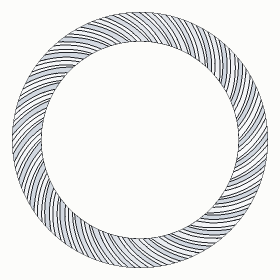
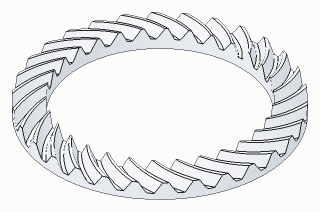
A face gear's 30 teeth cut whole by a tapered worm turning in mesh with it, as a hob cuts: a spiroid pair, the worm a single-start thread on a cone, over the gear's face on a shaft square to the gear's and 30 from it.
This is the third of five cases that cut a gear with its mate as the shafts move apart, from the straight bevel and the hypoid to the helicon and the worm wheel. Between the hypoid and the helicon, its pinion has become a worm and has not yet lost its taper.
The blank is the solid of revolution, about the z axis, of the quadrilateral in the xz-plane (ρ = x, z) with corners (40, −9), (52, −9), (52, −1.7) and (40, −0.3): a ring between radii 40 and 52 whose face is a cone falling 1.4 over its 12 of width, from z = −0.3 at its inner edge to −1.7 at its outer.
The worm's axis is the line through (0, 30, 6) along the x axis: square to the z axis and 30 from it. For a point p write x for its x coordinate, r for its distance from the worm's axis, and θ for its angle about the axis, right-handed about +x: (y − 30, z − 6) = r·(cos θ, sin θ). The worm's pitch cone has radius R(x) = 6 + x·tan 5° at x: it widens at 5° toward +x.
The tool is the worm's thread: the points with 0 ≤ x ≤ 52, |r − R(x)| ≤ 2.5 and |ξ| ≤ π/2 − (r − R(x))·tan 20°, where ξ is x − θ reduced to the interval [−π, π) by a multiple of 2π. It is a right-hand thread of lead 2π, one start, on a cone: its section by any plane through the axis is a row of trapezoids 2π apart (a rack of module 2), each π wide at the pitch cone, from 2.5 inside it to 2.5 outside, its sides 20° from square to the axis. Its tips and roots are cones, its ends the planes x = 0 and x = 52. It lies on one side of the gear's axis only, so it crosses the ring once, its narrow end nearest the gear's axis. The worm's core (r ≤ R(x) − 2.5) never reaches the blank, so a worm with its core cuts the same.
The motion. The worm turns by t about its axis, right-handed about +x (from +y toward +z), while the gear turns by t/30 about the z axis. Seen from the gear, the worm at t is turned by t about its axis and then by −t/30 about the z axis. t runs from 0 to 60π: thirty turns of the worm and one of the gear, after which each stands as it began. Cut from the blank everything the worm passes through, seen from the gear. Its ends never reach the blank.
Unlike the helicon's, this thread is no screw's: turned about its axis it does not slide into itself, because its radius changes along it. Seen from the gear the worm truly turns, about an axis square to the gear's and skew to it, so its flanks sweep envelopes of no planar motion. The gear's teeth run across its conical face, curved.
where K is the blank, T the thread and W the worm's axis.
Unsettled. This solid has no closed form, and no two kernels yet agree on it to 1e-8, so it has no answer to grade against. Below is what each kernel builds: built means a watertight, consistently oriented solid, whatever its measures; the table says which kernels agree with which.
Drawing
TopIsometricFrontRight
Third-angle projection, the three views at one scale. Drawn from next.BREP's result, which passed.
† works around a missing feature. Pick an entry to see its solid, its measures and its code.
Drag to turn, scroll or pinch to zoom, right-drag to move. The solid as its STEP file has it, meshed in the browser by Open CASCADE (occt-import-js): each face colored by the kind of its surface, and the edges that bound each face drawn between them.
Drag to turn, scroll or pinch to zoom, right-drag to move. Black lines are where the surface turns sharply; red ones, seen through the solid, are open edges, where the mesh is not closed.
cad-kernel left no solid to show.
Time
1.3 ms; CPU time 1.1 ms; peak memory 4.3 MB
Notes
refused cad-kernel has no tapered thread: it carries a section only by a slide, a turn or a screw at a constant radius (`build::carried`, `build::screwed`); and its sweep cut from a blank under a turn seen from another turn refuses a thread's curved flanks (`Unbuilt::Curved`)
//! A face gear hobbed whole by a tapered single-start worm: its thread a rack's trapezoid carried//! along a conical helix, each section in its half-plane through the axis.//!//! Refused: the tapered thread itself is not built. cad-kernel's sweeps of a section carry it only//! by a slide, a turn or a screw (`build::carried`'s `geom::Carry::{Line, Screw}`,//! `build::screwed`, `build::revolve`), each at a constant radius from its axis; none carries a//! section outward as it screws, and `build::lofted`/`build::sheets` take caller-made nets, which//! would be geometry computed outside the kernel. Nor would the cut follow: the kernel's sweep cut//! from a blank (`swept::closed::cut_from`) under a turn seen from another turn reads only a convex//! solid of revolution (K2) or a tool all planes and lines (`swept::general`), and refuses a//! thread's curved flanks (`Unbuilt::Curved`), as it does the constant-radius worm's in//! `worm-wheel-hobbed-by-its-worm` and `helicon-face-gear-hobbed-by-its-worm`.use cad_kernel::topo::Brep;
pubfnbuild() -> Result<Brep, String> {
Err("cad-kernel has no tapered thread: it carries a section only by a slide, a turn or a screw \
at a constant radius (`build::carried`, `build::screwed`); and its sweep cut from a blank \
under a turn seen from another turn refuses a thread's curved flanks (`Unbuilt::Curved`)"
.into())
}
occt left no solid to show.
Time
613 ms; CPU time 613 ms; peak memory 356.5 MB
Notes
refused occt has no sweep of a solid under two turns about skew axes at once, and a tapered thread's flanks under them are an envelope occt has no operation to find
"""A spiroid face gear hobbed by its tapered worm. A face gear's 30 teeth cut whole by a tapered worm
turning in mesh with it, as a hob cuts: a spiroid pair, the worm a single-start thread on a cone,
over the gear's face on a shaft square to the gear's and 30 from it.
This is the third of five cases that cut a gear with its mate as the shafts move apart, from the
straight bevel and the hypoid to the helicon and the worm wheel. Between the hypoid and the
helicon, its pinion has become a worm and has not yet lost its taper.
The blank is the solid of revolution, about the z axis, of the quadrilateral in the xz-plane (ρ =
x, z) with corners (40, −9), (52, −9), (52, −1.7) and (40, −0.3): a ring between radii 40 and 52
whose face is a cone falling 1.4 over its 12 of width, from z = −0.3 at its inner edge to −1.7 at
its outer.
The worm's axis is the line through (0, 30, 6) along the x axis: square to the z axis and 30 from
it. For a point p write x for its x coordinate, r for its distance from the worm's axis, and θ for
its angle about the axis, right-handed about +x: (y − 30, z − 6) = r·(cos θ, sin θ). The worm's
pitch cone has radius R(x) = 6 + x·tan 5° at x: it widens at 5° toward +x.
The tool is the worm's thread: the points with 0 ≤ x ≤ 52, |r − R(x)| ≤ 2.5 and |ξ| ≤ π/2 − (r −
R(x))·tan 20°, where ξ is x − θ reduced to the interval [−π, π) by a multiple of 2π. It is a right-
hand thread of lead 2π, one start, on a cone: its section by any plane through the axis is a row of
trapezoids 2π apart (a rack of module 2), each π wide at the pitch cone, from 2.5 inside it to 2.5
outside, its sides 20° from square to the axis. Its tips and roots are cones, its ends the planes x
= 0 and x = 52. It lies on one side of the gear's axis only, so it crosses the ring once, its
narrow end nearest the gear's axis. The worm's core (r ≤ R(x) − 2.5) never reaches the blank, so a
worm with its core cuts the same.
The motion. The worm turns by t about its axis, right-handed about +x (from +y toward +z), while
the gear turns by t/30 about the z axis. Seen from the gear, the worm at t is turned by t about its
axis and then by −t/30 about the z axis. t runs from 0 to 60π: thirty turns of the worm and one of
the gear, after which each stands as it began. Cut from the blank everything the worm passes
through, seen from the gear. Its ends never reach the blank.
Unlike the helicon's, this thread is no screw's: turned about its axis it does not slide into
itself, because its radius changes along it. Seen from the gear the worm truly turns, about an axis
square to the gear's and skew to it, so its flanks sweep envelopes of no planar motion. The gear's
teeth run across its conical face, curved."""from bench importRefuseddefbuild():
# The tapered thread itself occt could make (a pipe shell of the rack's trapezoid along a conical# helix, its trihedron held to the axis), but not what it fills as it turns about its axis while# that axis turns about the gear's: OCCT's sweeps slide, turn or carry a shape along a path, and# the gear's flanks are the envelope of the thread's under that motion.raiseRefused("occt has no sweep of a solid under two turns about skew axes at once, and a ""tapered thread's flanks under them are an envelope occt has no operation to ""find")
arris left no solid to show.
Time
It has not run.
Notes
missing no implementation
Data
No measures: it built no solid to measure.
Implementation
No implementation yet.
kentron left no solid to show.
Time
1.5 ms; CPU time 1.3 ms; peak memory 3.7 MB
Notes
refused kentron has no sweep of a solid along two turns about skew axes, nor of a tapered thread: `sweep::cut_by_motion` takes a prism moved in a plane or one screw or turn of a solid of revolution; the flanks are envelopes of the thread kentron has no operation to find
//! A face gear's 30 teeth cut whole by a tapered single-start worm turning in mesh with it: the//! worm turned by t about the line through (0, 30, 6) along x and then by −t/30 about the z axis,//! for t from 0 to 60π, cut from the conical ring between radii 40 and 52.//!//! Refused. The worm's thread is a thread on a cone, neither a prism nor a solid of revolution,//! and its two turns are about skew axes: kentron's cut by a motion (`sweep::cut_by_motion`)//! takes neither, and the teeth's flanks are envelopes of the thread kentron cannot find.usecrate::Refusal;
use kentron::topology::{Model, Shape};
pubfnbuild(_m: &mutModel) -> Result<Shape, Refusal> {
Err(Refusal::from(
"kentron has no sweep of a solid along two turns about skew axes, nor of a tapered thread: \
`sweep::cut_by_motion` takes a prism moved in a plane or one screw or turn of a solid of \
revolution; the flanks are envelopes of the thread kentron has no operation to find",
))
}
vcad left no solid to show.
Time
It has not run.
Notes
missing no implementation
Data
No measures: it built no solid to measure.
Implementation
No implementation yet.
solidcraft left no solid to show.
Time
1.5 ms; CPU time 1.2 ms; peak memory 4.6 MB
Notes
refused no layer (solidcraft-kernel, solidcore-ops, solidcore) has a sweep of a solid or an envelope: the face gear's flanks are the envelope of the tapered worm's thread turning about two skew axes at once, which no sweep of a profile along a line, a screw, a revolve or a path makes
//! Refused. Seen from the gear the tapered worm turns about its axis while that axis turns about//! the gear's, and the teeth's flanks are the envelope of the worm's thread over that motion.//! solidcraft-kernel has no sweep of a solid and no envelope, and its sweeps of a profile follow a//! line, a screw, a revolve or a path's own frame, none of which is this motion; an envelope//! computed here would be geometry made outside the kernel.usecrate::Refusal;
usecrate::solids::Body;
pubfnbuild() -> Result<Body, Refusal> {
Err("no layer (solidcraft-kernel, solidcore-ops, solidcore) has a sweep of a solid or an envelope: the face gear's flanks are \
the envelope of the tapered worm's thread turning about two skew axes at once, which \
no sweep of a profile along a line, a screw, a revolve or a path makes"
.into())
}
brepkit left no solid to show.
Time
It has not run.
Notes
missing no implementation
Data
No measures: it built no solid to measure.
Implementation
No implementation yet.
popkern left no solid to show.
Time
3.2 ms; CPU time 3 ms; peak memory 11.5 MB
Notes
refused popkern has no sweep of a solid, and this sweep's wall is an envelope its other operations do not make
// A spiroid face gear hobbed by its tapered worm.//// Refused: popkern has no sweep of a solid (its sweeps carry a profile along a path), and this// one's boundary is an envelope of the moving solid that its other operations do not make.throw"popkern has no sweep of a solid, and this sweep's wall is an envelope its other operations do not make";
aetheris left no solid to show.
Time
It has not run.
Notes
missing no implementation
Data
No measures: it built no solid to measure.
Implementation
No implementation yet.
Time
6.20 s; CPU time 6.19 s; peak memory 171.3 MB
Notes
built A watertight, consistently oriented solid; the case has no settled answer yet to grade it against.
Workaround † no sweep of a solid for a thread under its generating motion
Data
measured
volume
19123.9357239
area
13491.1852173
agrees with
no other kernel
faces
30 bspline, 60 cone, 60 other, 30 plane
mesh
115022 triangles, closed
centre of gravity
(-6.08483e-08, -6.97472e-09, -5.93929) its triangles
inertia
about it, of unit density: Ixx 2.04892e+07; Iyy 2.04892e+07; Izz 4.082e+07; Ixy -0.217355; Iyz 0.000598818; Izx 0.00483374
not by the harness, which graded the runner's own measures instead: cannot measure: face #382051: a loop whose path on its surface breaks (an edge laid across a place where its surface meets itself?)
//! A spiroid face gear hobbed by its worm.//!//! The kernel's sweep of a thread under two turns (`solid_sweep_thread`), as for the helicon: the//! worm's thread on its pitch cone (axis through (0, 30, 6) along x, R(x) = 6 + x·tan 5°, lead 2π,//! π wide at the cone, flanks 20°, 2.5 either side of it, ends x = 0 and x = 52), turned by t about//! its axis and then by −t/30 about the z axis for t from 0 to 60π, cut from the ring blank (radii//! 40 to 52, from z = −9 to its conical face, −0.3 at the inner edge and −1.7 at the outer). The//! kernel traces one tooth space, cuts it from the blank's cell between two teeth and sews the 30//! cells: the sweep, its spaces and the gear are all made inside it, from the case's data alone.usecrate::solids::p;
usecrate::Refusal;
use brep_kernel::solid_sweep_thread::{thread_gear, RingBlank, ThreadTool};
use brep_kernel::{BrepSolid, TwoTurns};
use std::f64::consts::{FRAC_PI_2, PI, TAU};
pubfnbuild() -> Result<BrepSolid, Refusal> {
let axis = (p(0.0, 30.0, 6.0), p(1.0, 0.0, 0.0));
let thread = ThreadTool {
axis_point: axis.0,
axis_direction: axis.1,
// θ = 0 along +y, right-handed about +x.
reference: p(0.0, 1.0, 0.0),
lead: TAU,
pitch_radius: 6.0,
taper: 5f64.to_radians().tan(),
half_width: FRAC_PI_2,
flank_tan: 20f64.to_radians().tan(),
tip: 2.5,
root: 2.5,
start: 0.0,
end: 52.0,
};
let motion = TwoTurns { axes: [axis, (p(0.0, 0.0, 0.0), p(0.0, 0.0, 1.0))], rates: [1.0, -1.0 / 30.0], from: 0.0, to: 60.0 * PI };
let blank = RingBlank { inner: 40.0, outer: 52.0, bottom: -9.0, face: -0.3, face_outer: -1.7 };
Ok(thread_gear(&thread, &motion, &blank, 30)?)
}
geop left no solid to show.
Time
1.8 ms; CPU time 1.6 ms; peak memory 8.9 MB
Notes
refused geop sweeps a profile along a path, turning it with the path; it has no sweep of a solid through a motion, and the face gear's teeth are bounded by the envelope of the worm's thread as both turn, which geop cannot build
//! A spiroid face gear hobbed by its tapered worm.//!//! geop sweeps a profile along a path, turning it with the path; it has no sweep of a solid//! through a motion, and the face gear's teeth are bounded by the envelope of the worm's thread as//! both turn, which geop cannot build.usecrate::{Bench, Refusal};
pubfnbuild(_: &mutBench) -> Result<(), Refusal> {
Err("geop sweeps a profile along a path, turning it with the path; it has no sweep of a \
solid through a motion, and the face gear's teeth are bounded by the envelope of the \
worm's thread as both turn, which geop cannot build"
.into())
}
Time
2.36 s; CPU time 6.13 s; peak memory 99 MB
Notes
built A watertight, consistently oriented solid; the case has no settled answer yet to grade it against.
Its volume and area are its STEP file's, as the harness measures them from the file's exact geometry (harness/mass/); its triangles are Open CASCADE's mesh of the file, for the pictures.
Data
its STEP's
volume
19123.8210352
area
13497.01327
agrees with
no other kernel
mesh
507238 triangles, closed
centre of gravity
(-1.51586e-08, 7.4742e-10, -5.94678) its STEP's solid
inertia
about it, of unit density: Ixx 2.04601e+07; Iyy 2.04601e+07; Izz 4.07624e+07; Ixy 0.00356049; Iyz -3.7678e-05; Izx 0.000382697
//! A face gear, the ring between radii 40 and 52 about the z axis whose face is a cone falling//! 1.4 across it, hobbed whole by a tapered single-start worm on the line through (0, 30, 6)//! along x, from x = 0 to 52: the worm turns by t about its axis while the gear turns by t/30,//! t from 0 to 60π.//!//! The ring is its meridian quadrilateral revolved. The thread is its section in the half plane//! through the worm's axis (between the cones 2.5 inside and outside the pitch cone, its sides//! 20° from square to the axis) carried along the spiral on the pitch cone by the spiral's own//! screw (cadrs's sweep with `SweepControl::Helix`: turned about the axis as the path turns,//! moved along it and out from it as the cone widens, so the section stays in a plane through//! the axis), a turn past each end, cut to its ends and placed. Then cadrs's cut by a moving//! tool under the two turns (`Kernel::cut_swept`).//!//! Across this ring a patch of the thread's second flank's envelope comes out from under the//! path of its crest's edge partway along the tooth: toward the ring's outside a tooth space//! has that fifth face, and cadrs makes the space in two stretches (nine faces a space).usecrate::bench::{moved, p3, revolve, turned, v3, P3};
usecrate::shared::swept::{cut_swept_exactly, z_axis};
usecrate::Refusal;
use cadrs_kernel::{Axis, BodyId, BoolOp, DefaultKernel, Helix, Kernel, Loop, Plane, Profile, RigidStep, SolidMotion, SweepControl, SweepSpec};
use std::f64::consts::{FRAC_PI_2, PI, TAU};
/// The tapered worm's thread on the line through `at` along x, from x = `from` to `to`: built/// about the z axis (the pitch radius 6 + z·tan 5° at height z), then turned by 90° about the/// y axis and moved to `at`, as the helicon's cylindrical thread is (`shared::swept::worm_thread`).fntapered_thread(k: &mutDefaultKernel, at: P3, from: f64, to: f64) -> Result<BodyId, Refusal> {
let (tan5, tan20) = (5f64.to_radians().tan(), 20f64.to_radians().tan());
let pitch = |z: f64| 6.0 + z * tan5;
let w = |u: f64| FRAC_PI_2 - u * tan20;
let start = -TAU * ((-from / TAU).ceil() + 1.0);
let mid = start - FRAC_PI_2;
// the section's corners: u from the pitch cone, at the heights mid ∓ w(u)let corner = |u: f64, side: f64| {
let z = mid + side * w(u);
[pitch(z) + u, z]
};
let section = [corner(-2.5, -1.0), corner(2.5, -1.0), corner(2.5, 1.0), corner(-2.5, 1.0)];
let profile = Profile::of(Plane::xz(0.0), vec![Loop::polygon(§ion)]);
let turns = ((to - start) / TAU).ceil() + 1.0;
let spiral = Helix::conical(Axis::new(p3(0.0, 0.0, mid), v3(0.0, 0.0, 1.0)), pitch(mid), pitch(mid + TAU * turns), TAU * turns, 0.0, turns);
letmut spec = SweepSpec::solid(spiral.path());
spec.control = SweepControl::Helix(spiral);
let thread = k.sweep_with(&profile, &spec)?.first()?;
let ends = crate::bench::cylinder(k, p3(0.0, 0.0, from), v3(0.0, 0.0, 1.0), 20.0, to - from)?;
let thread = k.boolean(BoolOp::Intersect, thread, &[ends])?.first()?;
let thread = turned(k, thread, Axis::new(P3::origin(), v3(0.0, 1.0, 0.0)), 90.0)?;
moved(k, thread, at.coords)
}
pubfnbuild(k: &mutDefaultKernel) -> Result<BodyId, Refusal> {
let quad = [[40.0, -9.0], [52.0, -9.0], [52.0, -1.7], [40.0, -0.3]];
let ring = revolve(k, &Profile::of(Plane::xz(0.0), vec![Loop::polygon(&quad)]), z_axis(), None)?;
let at = p3(0.0, 30.0, 6.0);
let thread = tapered_thread(k, at, 0.0, 52.0)?;
let motion = SolidMotion::Rigid {
steps: vec![
RigidStep::Turn { axis: Axis::new(at, v3(1.0, 0.0, 0.0)), from: 0.0, to: 60.0 * PI },
RigidStep::Turn { axis: z_axis(), from: 0.0, to: -TAU },
],
};
cut_swept_exactly(k, ring, thread, &motion)
}
smlib left no solid to show.
Time
It has not run.
Notes
missing no implementation
Data
No measures: it built no solid to measure.
Implementation
No implementation yet.
springrep left no solid to show.
Time
1.4 ms; CPU time 1.2 ms; peak memory 3.7 MB
Notes
refused springrep's sweep of a solid is exact only under a slide, a turn or a screw. The tooth (or thread) is carried by two turns at once, about the blank's axis and the mating one, so the space it cuts is bounded by envelopes of its flanks under that motion, which it cannot make exactly
//! A face gear's 30 teeth cut from a coned ring by a tapered worm thread turning in mesh.use springrep::topo::Brep;
pubfnbuild() -> Result<Brep, String> {
Err("springrep's sweep of a solid is exact only under a slide, a turn or a screw. The tooth (or thread) is carried by two turns at once, about the blank's axis and the mating one, so the space it cuts is bounded by envelopes of its flanks under that motion, which it cannot make exactly".into())
}
geomsolver left no solid to show.
Time
327 ms; CPU time 327 ms; peak memory 24.1 MB
Notes
crashed /home/runner/work/brep-bench/brep-bench/kernels/geomsolver/cases/swept/spiroid_face_gear_hobbed_by_its_worm.sv:91:1: note[N080]: not built: it is built on `thread`, made of `thread` (76:1), which could not be built
// A spiroid face gear's 30 teeth hobbed by its tapered worm. The blank is the given quadrilateral// in the front plane (x, z) turned whole about z: a ring from radius 40 to 52 with a conical face.// The worm's axis is the line through (0, 30, 6) along x, its pitch cone R(x) = 6 + x tan 5.// Its thread is a face family: at each station s (radians), in the half-plane through the axis// turned s about it, the rack tooth centred at x = s - pi wide at the pitch cone, from 2.5 inside// it to 2.5 outside, its sides 20 degrees from square to the axis - whose corners ride the cone as// it grows; the thread is that section as s runs, kept between x = 0 and 52. The worm turns t// about its axis while the gear turns t/30 about z; the kernel's sweep of the thread as the gear// sees it, over thirty turns of the worm, is cut from the blank.unit mm
use std
use std.solids (cut, common)
use std.place (coords)
use std.shapes
use std.motion (turns)
taper := tan(5deg)
side := tan(20deg)
in std.front {
private k0 := point
private k1 := point
private k2 := point
private k3 := point
fix((40, -9)) k0
fix((52, -9)) k1
fix((52, -1.7)) k2
fix((40, -0.3)) k3
private underside := line(k0, k1)
private rim := line(k1, k2)
private face_cone := line(k2, k3)
private bore := line(k3, k0)
construction centerline gear_axis := line(std.origin, hint((0, 1)))
fix((0, 1)) gear_axis.p2
}
part := solid(std.solids.Revolution(face(underside, rim, face_cone, bore), about: gear_axis))
// the worm's axis, and the half-plane through it toward +y the thread's section is drawn inprivate along := axis
fix(dir == (1, 0, 0)) along
private out := axis
fix(dir == (0, 1, 0)) out
section_plane := plane(u: along, v: out)
fix(origin == (0, 30, 6)) section_plane
in section_plane {
private w0 := point
private w1 := point
w0 coords(du: -1mm, dv: 0mm) section_plane
w1 coords(du: 1mm, dv: 0mm) section_plane
construction centerline worm_axis := line(w0, w1)
}
// the thread: at station s the section stands turned s about the axis, centred s along it, its// root and tip 2.5 either side of the pitch cone there and its flanks 20 degrees from squareparam s: Scalarover (-3, 56)
lay := frame
lay turns(1) worm_axis
fix(value == s * 1rad) lay
in lay {
in section_plane {
private r0 := point
private r1 := point
private r2 := point
private r3 := point
r0 coords(du: (s - pi / 2 - 2.5 * side) * 1mm, dv: (6 + (s - pi / 2 - 2.5 * side) * taper - 2.5) * 1mm) section_plane
r1 coords(du: (s + pi / 2 + 2.5 * side) * 1mm, dv: (6 + (s + pi / 2 + 2.5 * side) * taper - 2.5) * 1mm) section_plane
r2 coords(du: (s + pi / 2 - 2.5 * side) * 1mm, dv: (6 + (s + pi / 2 - 2.5 * side) * taper + 2.5) * 1mm) section_plane
r3 coords(du: (s - pi / 2 + 2.5 * side) * 1mm, dv: (6 + (s - pi / 2 + 2.5 * side) * taper + 2.5) * 1mm) section_plane
private root := line(r0, r1)
private lead_flank := line(r1, r2)
private tip := line(r2, r3)
private trail_flank := line(r3, r0)
tooth := face(root, lead_flank, tip, trail_flank)
}
}
construction thread := solid({ p | some s: p in tooth at s })
in std.side {
private m := point
fix((30, 6)) m
private span := std.shapes.CenteredRectangle(m, w: 40mm, h: 40mm)
}
construction ends := solid(std.solids.Prism(span.loop, from: 0mm, to: 52mm))
ends common thread
// the worm turning about its axis, the gear a thirtieth as fast about z, and what the thread// passes through as the gear sees it over thirty turns of the worm
worm := frame
worm turns(1) worm_axis
gear := frame
gear turns(1 / 30) gear_axis
construction hob := solid({ p | some t in (0deg, 10800deg): p in thread at(under: worm, seen_from: gear) t })
hob cut part
anvilcad left no solid to show.
Time
1.2 ms; CPU time 1 ms; peak memory 3.4 MB
Notes
refused anvil-brep has no sweep of a solid and no helical curve: a body screwed along an axis sweeps envelopes of its surfaces under the screw, which it cannot make from its profile sweeps
//! A spiroid face gear hobbed by its tapered worm.use anvil_brep::Solid;
pubfnbuild() -> Result<Solid, String> {
Err("anvil-brep has no sweep of a solid and no helical curve: a body screwed along an axis sweeps envelopes of its surfaces under the screw, which it cannot make from its profile sweeps".into())
}